Jackie's ToysRare · Antique · Vintage
Launch promo ends in 00:00:00
Get the Handbook — $47 $27
Jackie · What old toys are really worth

In a box of thirty old toys, one is worth more than the other twenty-nine put together.

And it does not look any different. Most old toys are not worth much — the great majority of what comes out of an American attic brings somewhere between nothing and forty dollars. This handbook is about telling which one is the exception before it goes in a yard-sale box for a dollar.

Instant download · Yours forever

44
Chapters
145
Pages
8
Parts
Jackie in her collection room

“For everyone who was told to throw the box away.”

Dedication — The Attic Goldmine Handbook
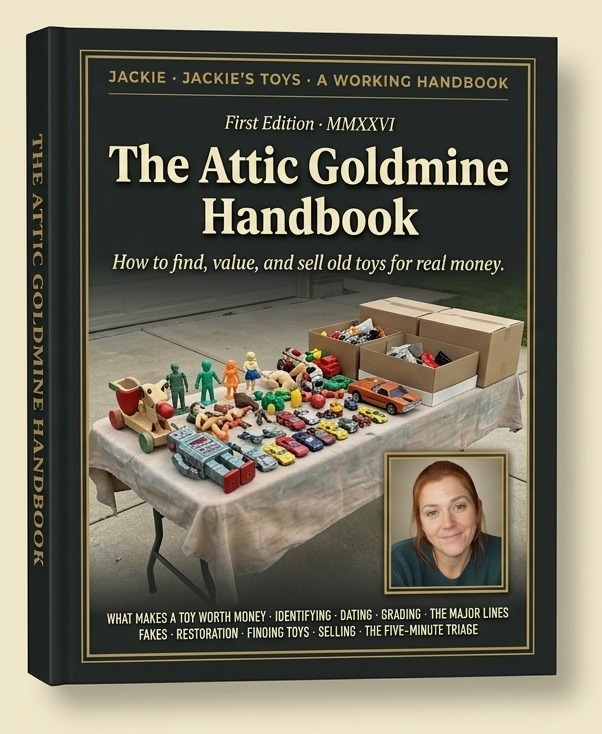
The Attic Goldmine Handbook — First Edition
Section I — The Handbook

A working manual, not a coffee-table book.

There are no glossy full-page photographs of toys you will never own. What there is instead is the actual method: how to figure out what something is, what condition it is really in, what somebody will genuinely pay for it — and how to get that money into your hands without being cheated along the way.

I want to be honest with you on the first page, because everything after it depends on you trusting me. Most old toys are not worth much. If you came here because a video told you your childhood toys are a hidden fortune, I would rather disappoint you now than take your money and disappoint you on page ninety.

But here is the other half of that truth, and it is the reason the book exists. Value in this hobby is wildly uneven. Two toys can come off the same tooling in the same year and differ by fifty times in value because of a change made mid-run at a factory in 1978. The nine-dollar version and the nine-hundred-dollar version look alike until you know what to look at.

“In several major toy categories, the empty original box is worth more than the toy that came in it. I do not say that to be clever. I say it because if you understand why it is true, you will never again throw away a piece of printed cardboard from an attic.” Chapter 02 — Why the Box Is Worth More Than the Toy

Some of what is in here comes from videos I have posted. Most of it goes a great deal further, because a ten-minute video can tell you that a certain Hot Wheels car sold for eleven thousand dollars, but it cannot teach you how to look at the car in your own hand and know whether you are holding that one or a fifty-cent version of the same casting. That difference is the entire hobby.

Section II — The Difference

The same box of toys, opened two ways.

More value is destroyed in the first hour after discovery than at any other point in a toy's life — almost always by somebody trying to help. Here is what that hour looks like either way.

The way most attics get emptied
The first hourEverything gets tipped out, wiped down and sorted into a nice new plastic tote so it looks presentable.
The cardboardBoxes, cards, trays and instruction sheets go straight in the trash. It's packaging.
Identifying it“A Star Wars Jawa.” “A Hot Wheels Camaro.” Close enough to look up.
Pricing itSearch the name, see somebody asking $900, assume that's the number — or see $9 and give up.
ConditionA feeling. “Pretty good for its age.”
The batteriesLeft in, the way they have been since 1987.
SellingOne pile, one buyer, one afternoon. Whatever they offer for the lot.
The way this handbook empties one
The first hourThe five-minute triage. Photograph the space, touch nothing, sort into four piles by packaging — and clean absolutely nothing.
The cardboardPile four. Sealed or boxed items run roughly ten to forty times the loose price; a used box still means four to eight.
Identifying itDown to the production run. Vinyl cape or cloth. Hong Kong base, enamel colour, interior. Chapters 6–11 are only about this.
Pricing itSold listings only. Discard the highest and lowest results, take the middle of the cluster — asking is not selling.
ConditionThe grading language collectors actually use — paint wear at high points, joint tightness, sticker lift, bubble yellowing, seal.
The batteriesOut today, every compartment, before corrosion finishes what it started.
SellingThe right venue per item — marketplace, auction house, toy show or direct — and packed so it survives the trip.

Section III — What's Inside

Forty-four chapters, in eight parts.

Read it in any order — go straight to whatever is sitting in front of you. But if you read only one page first, read the Five-Minute Triage, because it is the page that stops you destroying something before you have identified it.

Before You Begin

The Five-Minute Triage

  • ·Before You Begin — what this book is and is not
  • ·How to Use This Book
  • ·The Five-Minute Triage — the whole box, sorted, in five minutes
Part One

What Makes a Toy Worth Money

  1. 01The Four Things That Set Every Price
  2. 02Why the Box Is Worth More Than the Toy
  3. 03Scarcity Is Not the Same as Rarity
  4. 04Nostalgia Economics: Who Is Buying and Why
  5. 05The Toys Everyone Thinks Are Valuable and Aren't
Part Two

Identifying and Dating

  1. 06Reading the Markings
  2. 07Dating a Toy When There Are No Markings
  3. 08Variants: How One Small Difference Multiplies the Price
  4. 09Prototypes, Samples, and Factory Errors
  5. 10Building Your Reference Library for Free
  6. 11Photographing a Toy So You Can Identify and Sell It
Part Three

Condition and Grading

  1. 12The Grading Language Every Collector Uses
  2. 13Grading a Loose Toy: A Practical Walkthrough
  3. 14Grading Carded and Boxed Toys
  4. 15Professional Grading: When It Pays and When It Burns Money
  5. 16The Damage That Kills Value and the Damage Nobody Minds
Part Four

The Major Toy Lines

  1. 17G.I. Joe: The Twelve-Inch Era and the Real American Hero
  2. 18Hot Wheels: Redlines, Bases, and the Cars Worth Thousands
  3. 19Matchbox, Corgi, and Dinky: The Other Die-Cast Money
  4. 20Barbie: 1959 Through the Collector Boom
  5. 21Cabbage Patch Kids: Signatures, Head Molds, and Real Rarities
  6. 22Star Wars: The Kenner Era and Why It Rules the Hobby
  7. 23Transformers, He-Man, and 1980s Action Figure Gold
  8. 24LEGO: Sealed Sets, Minifigures, and Sorting by Weight
  9. 25Board Games and the Monopoly Question
  10. 26Tin, Cast Iron, and Pre-War Toys
  11. 27The 1990s and 2000s: What Is Rising Now
Part Five

Fakes, Reproductions, and Restoration

  1. 28How Reproduction Parts Enter the Market
  2. 29Spotting a Resealed Card or a Reproduction Box
  3. 30Fake Signatures, Fake Stickers, Fake Everything
  4. 31Restoration and Cleaning: What Helps and What Destroys
Part Six

Finding Toys

  1. 32Estate Sales: The Best Source in America
  2. 33Thrift Stores, Flea Markets, and Garage Sales
  3. 34Buying Online Without Getting Burned
  4. 35Auctions, Storage Units, and Bulk Lots
Part Seven

Selling

  1. 36Finding the Real Price Before You Sell Anything
  2. 37Selling on the Major Marketplaces
  3. 38Auction Houses and Consignment
  4. 39Toy Shows, Collector Groups, and Selling Direct
  5. 40Shipping Without Destroying What You Just Sold
  6. 41Records, Taxes, and Treating This Like a Business
Part Eight

Keeping It

  1. 42Storage: Light, Heat, Humidity, and the Wrong Plastic
  2. 43Inventory, Insurance, and What Happens Next
  3. 44Buying Smart: Building a Collection That Holds Value
Reference

The Back of the Book

  • ·The Attic Triage Checklist — take it to the attic and work it in order
  • ·Glossary — every term collectors use, in plain language
  • ·Where to Look Things Up — the four bookmarks to build per toy line
Get the Handbook — $47 $27

Instant download · Yours forever

Section IV — Reader Results

What readers found in the box.

My mother kept every box. The whole family teased her about it for thirty years. I read chapter two on a Sunday and went back up to that attic on the Monday with a completely different set of eyes.

Denise M.Cleared her parents' attic · Missouri

The chapter on the toys people think are valuable saved me a consignment fee and an argument with my sister. It also told me which two things in the tote were actually worth researching properly.

Ray T.Estate sales, weekends · Ohio

I had been pricing off asking prices for two years without knowing there was a difference. Sold listings only, throw out the top and the bottom, take the middle. That one page changed what I pay at flea markets.

Marisol V.Reselling since 2023 · Arizona

Jackie
Section V — About

I write down the part that doesn't fit in a video.

I have spent my life around old toys — buying them, sorting them, arguing about them, and watching people give away the one good thing in the box because it did not look like the good thing. The videos I post are the short version. This book is the long one.

Every chapter is built the same way, because a repeated shape is easier to use standing in a garage than a clever one. It opens by telling you plainly what the problem is and what you are going to learn to do about it. Then it walks the method the way one person walks another through it at a kitchen table, with the real details included rather than glossed over — the actual markings, the actual variants, the actual price bands as they stand in 2026.

Near the end of most chapters there are two short sections. The first tells you what the method does not do, where it fails, and what mistake people make with it. The second gives you the money: what the thing is likely worth, what it costs you to find out, and where the number came from.

About the prices. Every figure in the book is a range, not a promise. Toy values move, sometimes sharply, and any book that gives you one exact number for a collectible is either lying to you or out of date. I have used ranges that reflect completed public sales through the first half of 2026, and I have tried to be conservative rather than exciting.

JackieAuthor · The Attic Goldmine Handbook
Section VI — Order

Know what it is before you let it go.

The Attic Goldmine Handbook

First Edition · 2026
  • The complete handbook — 145 pages, 44 chapters in eight parts, PDF
  • The Five-Minute Triage — sort a whole box before you touch anything you shouldn't
  • The four factors that set every price, run in the order that actually works
  • Eleven chapters on the major lines — Star Wars, Hot Wheels, G.I. Joe, Barbie, Transformers, LEGO, tin and cast iron, and the rest
  • How to spot a resealed card, a repro box, and a fake signature
  • The Attic Triage Checklist — printable, worked in order, from "do not clean anything" to storage
  • A plain-language glossary of every term collectors use, plus the four references to build per toy line
$47$27
Get the Handbook — $47 $27

Instant download · Yours forever

Visa · Mastercard · Amex · PayPal — secure checkout via Gumroad
Section VII — Questions

Questions people ask before they buy.

Are the prices in here real?

They are ranges, and they are labelled as ranges. Every figure reflects completed public sales through the first half of 2026 — sold results, not asking prices — and I have deliberately erred on the conservative side rather than the exciting side.

What the book will not do is hand you one exact number for a collectible, because any book that does that is either lying to you or out of date. Chapter 36 teaches you how to check any figure yourself, on the day, and it is the single most important chapter in here. Use my numbers to know roughly where you are standing; use Chapter 36 before you buy or sell anything.

Your videos are free. Why would I buy this?

Because a video has to hold your attention and a book only has to be right. Ten minutes can tell you that a Hot Wheels car sold for eleven thousand dollars. It cannot teach you to look at the car in your own hand and tell whether you are holding that one or a fifty-cent version of the same casting — that takes the base markings, the wheel type, the enamel colour and the interior, and it takes pages.

The other reason is order. The book is built so that the early chapters hold up everything after them, and so the checklist at the back works standing in an attic. On a channel you get whatever I happened to film that week.

Why only $27 for a 145-page handbook?

Because of who I want reading it. The people who need the first hour of the triage most are the ones clearing a parent's house this month, and they are not going to spend two hundred dollars on a maybe. Twenty-seven dollars is less than most people lose on one item sold badly at a yard sale. If the book is worth anything at all, it clears that on the first thing you correctly do not throw away — and if it is not, I would rather you found that out cheap.

I don't have anything rare. Is this still for me?

Probably, and here is the honest version. Most of what comes out of an attic is worth between nothing and forty dollars, and this book says so on page one. What it is built to do is find the exception in the pile and stop you destroying it in the first hour — because that first hour is when most of the value in this hobby disappears, almost always at the hands of somebody trying to be helpful.

If it turns out there is nothing exceptional in your box, you will know that in an afternoon instead of wondering about it for ten years.

Is this a price guide?

No, and I would not sell you one. Printed price guides are useful for identification and dangerous for value, because the numbers are stale the month they are printed. This is a method book: how to identify a thing precisely, how to grade it against the vocabulary collectors actually use, how to find what it genuinely sold for this week, and how to sell it in the right venue without wrecking it in the post.

What format is it, and how do I get it?

A PDF, delivered the moment you buy through Gumroad. It reads on a phone in an attic, on a tablet, or on a laptop, and it prints if you would rather have the triage checklist on paper — most people print the checklist and keep the rest on the phone. Instant download, and it is yours to keep.

Is this an appraisal, or financial advice?

Neither. It is educational information about collectible toys, written by a collector. It is not a professional appraisal, and it is not financial, tax, or legal advice. Values in this hobby move, sometimes sharply, and they vary by region, venue and the day of the week. For insurance, probate, or anything you believe is worth serious money, get a second opinion from a qualified appraiser or a specialist auction house before you act.